
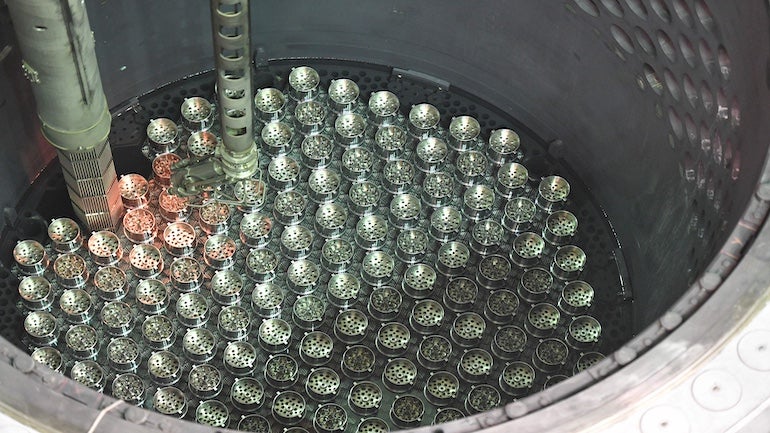
The final cycle of pilot operation of VVER accident tolerant fuel (ATF) has been successfully completed at unit 2 of Russia’s Rostov Nuclear Power Plant (NPP). This strategic initiative involved the loading of three innovative fuel cassettes into the VVER-1000 reactor, marking a significant step after three complete fuel campaigns of 18 months each conducted since 2021.
The pilot operation program featured three TVS-2M combined assemblies, each consisting of 12 cutting-edge fuel rods. Six of these rods were constructed from 42KhNM chromium-nickel alloy, while the other six utilized chromium-coated zirconium alloy shells. The introduction of these advanced materials aims to significantly mitigate or eliminate the concerns associated with the zirconium vapour reaction during potential emergency scenarios within the reactor core.
One of the primary risks addressed by these new fuel rod designs is the zirconium-water (vapour) reaction, which poses a serious threat during a “loss-of-coolant” accident. Traditionally, zirconium alloy is favored for fuel rod cladding because its properties allow efficient reactions without absorbing neutrons. However, if reactor cooling is compromised and temperatures escalate beyond 800°C, zirconium becomes reactive, leading to dangerously brittle cladding and the potential for catastrophic core meltdowns due to hydrogen gas explosions.
The ATF fuel rods introduced utilize the much more inert 42KhNM chromium-nickel alloy that remains stable under high temperatures, or the chromium-coated zirconium that employs a thin chromium layer to shield the zirconium beneath from steam exposure, thus preventing hazardous reactions.
Initial evaluations of the ATF rods removed from the Rostov reactor have shown promising results. Inspections revealed that the fuel rods preserved their hermetic seals and structural integrity impeccably. Remarkably, they were described as “practically indistinguishable from fresh fuel” even after extended service within the reactor core. The rods are now slated for further examination at the Research Institute of Atomic Reactors (NIIAR) in Dimitrovgrad, where both destructive and non-destructive testing will verify any internal material changes.
Following these successful trials, Rosatom has favored the chromium-coated zirconium alloy for future large-scale industrial application due to its advantageous economic and technological balance. This choice marks a pivotal moment in the evolution of reactor fuel technology.
During the pilot program, a significant discovery was made regarding the chromium-plated surface’s properties, which allow for the removal of several manual assembly steps. This breakthrough is essential for the envisioned fully automated, unmanned production of next-generation fuel types, such as TVS-5, as well as mixed uranium-plutonium fuels.
In response to the positive outcomes at Rostov, a dedicated production line has been established at the Chepetsky Mechanical Plant to facilitate large-scale application of these coatings. The final stage of qualification necessitates loading full ATF fuel assemblies containing all 312 rods into a high-power commercial reactor for a comprehensive trial before widespread implementation across the VVER fleet.
The fuel assemblies have successfully completed three full fuel campaigns and are now undergoing thorough documentation processes to satisfy regulatory requirements with Rostechnadzor. The completed fuel will soon transition to post-reactor research at NIIAR, as noted by Rostov NPP Director Andrey Salnikov.
According to Alexander Ugryumov, Senior Vice President for Scientific & Technical Activities at Rosatom’s Fuel Division, the choice of a classic zirconium alloy with a chromium coating stands as the optimal solution for industrial adaptation, reaffirming a consensus among leading global nuclear fuel manufacturers. In the context of Russia’s strategy to close the nuclear fuel cycle, advancements from the ATF development program hold significant implications for enhancing the efficiency and safety of nuclear operations moving forward.
