
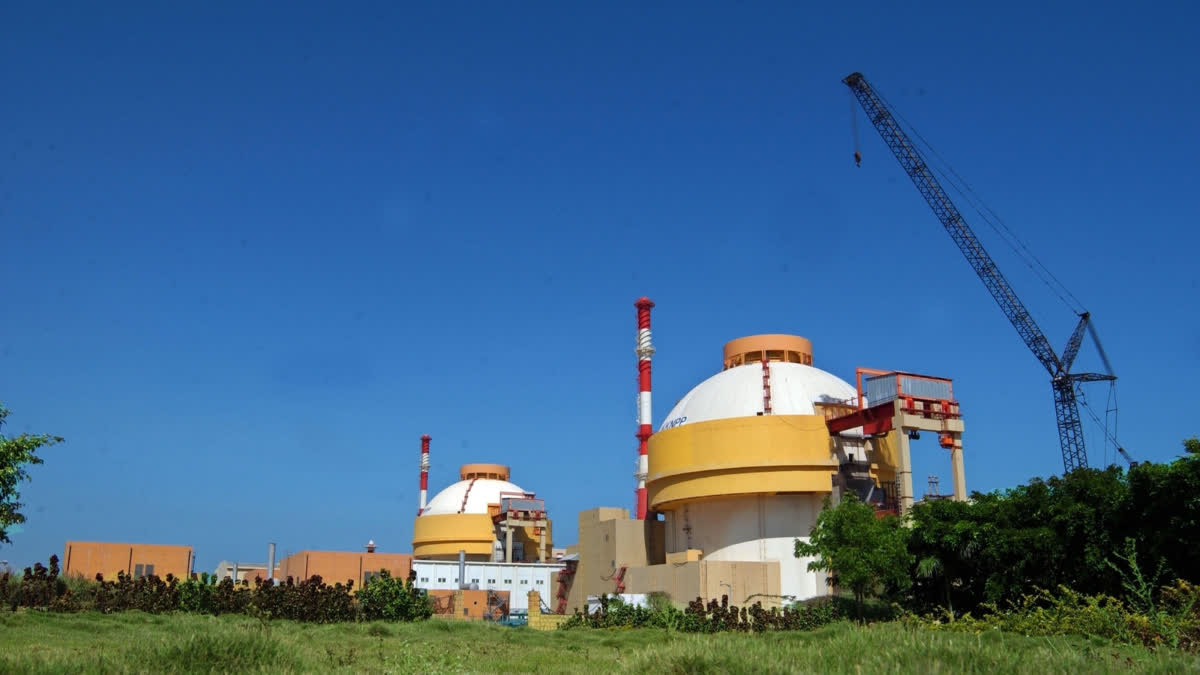
Kudankulam Nuclear Power Plant (file photo) (IANS)
Bihar’s First Nuclear Power Plant: A Leap Toward Clean Energy
Patna: Bihar is on the cusp of a significant energy revolution with plans to establish its first nuclear power plant. This 2,000 MW facility, set to be developed by the Nuclear Power Corporation of India Limited (NPCIL) and NTPC, will utilize cutting-edge Small Modular Reactor (SMR) technology. With an estimated investment of about Rs 20,000 crore, the project is earmarked for Rajauli in Nawada district. Once operational, this plant will seamlessly integrate into India’s Nuclear Energy Mission, aimed at promoting clean energy while also stimulating regional development.
A Vision for Clean Energy
Bihar’s Energy Minister Bijendra Prasad Yadav has emphasized the necessity for nuclear energy. He pointed out that conventional coal and thermal power sources are among the largest carbon dioxide emitters. “We’ve completed surveys at three locations and are preparing to engage in further discussions with the Centre to bring the nuclear plant to life,” he said.
The Journey Begins
The idea for the nuclear plant gained momentum following a conference of power ministers in Patna last June, presided over by Union Power Minister Manohar Lal Khattar. At the state’s request, discussions centered around the establishment of this modern facility using SMR technology. NPCIL and NTPC have since conducted extensive surveys in Banka, Siwan, and Nawada. Their findings evaluated seismic stability, land and water availability, and potential radioactivity concerns, revealing that SMR plants require a substantial amount of water—about 500-700 gallons per megawatt-hour of electricity produced.
Currently, Nawada and Banka appear to be the frontrunners due to their relatively low seismic activity, although they grapple with water scarcity. Siwan, although not facing water shortages, is risky due to its seismic classification. The final decision regarding the location rests with the Centre, with the Bihar government anticipating construction to kick off in 2027-28.
Growing Demand for Power
Bihar is experiencing an unprecedented surge in electricity consumption, having seen an increase of over 11 times in the last 20 years. Back in 2005, the state consumed merely 700 MW, a number that skyrocketed to 8,005 MW recently. The consumer base has also ballooned, from 1.7 million to over 21.2 million in the same timeframe.
This nuclear power plant will be pivotal in addressing the predicted rise in energy consumption, especially as the Bihar government aims to foster industrialization across the state. Notably, electricity generation in Bihar has risen from zero two decades ago to about 12,000 MW today. Improved management has also reduced technical and commercial losses from over 45% to below 20%.
The Nitish government has been extending 125 units of free electricity to over 18.9 million consumers. However, this initiative places a substantial burden on the state’s finances, given the high costs involved in purchasing electricity from NTPC. Therefore, diversifying energy sources—be it solar or nuclear—has become increasingly crucial.
Balancing Energy Sources
While thermal power stations currently dominate Bihar’s electricity landscape, the state is also venturing into solar energy. A 2,000 MW solar plant has been established in Kajra, Lakhisarai, with additional solar projects underway in Banka.
Expert Insights on Nuclear Energy
Economist N.K. Chaudhary highlights the urgency for alternative energy sources amid global uncertainties. He asserts that given the volatility in oil supply—exacerbated by geopolitical tensions—the need to reduce reliance on fossil fuels has never been more critical. “Nuclear energy holds immense promise for Bihar. It is a clean energy source, with radiation being its only potential drawback,” he explains, advocating for a balanced approach that incorporates both nuclear and solar energy.
Understanding Small Modular Reactors (SMRs)
SMRs are a revolutionary advancement in nuclear technology, offering a capacity range of 30-300 MW. Designed to be manufactured in factories and assembled on-site, these reactors significantly reduce construction times and cost efficiencies. Enhanced passive safety features minimize the chances of radioactive leaks, making them suitable even for locations where space is limited.
Current Nuclear Landscape in India
As of now, India has 24 operational nuclear power plants across several states, including Gujarat, Maharashtra, Rajasthan, Tamil Nadu, Karnataka, and Uttar Pradesh, yielding a peak capacity of 8,780 MW. Nuclear energy contributes a mere 3.1% to the country’s total electricity generation, but ambitious goals are set to elevate this contribution to 22,480 MW by 2031-32 and 100 GW by 2047, mainly through the deployment of SMRs across various states.