
Rooftop Solar’s Impact on Christmas Day 2025 in Australia
In a nation marked by sun-kissed rooftops, Christmas Day 2025 saw thousands of solar panel systems come alive, contributing significantly to the electricity consumed during festive celebrations. These solar systems helped not only to provide cleaner energy but also to reduce the costs associated with powering homes during one of the busiest days of the year.
Solar Power Contribution to Grid Demand
Australia’s solar energy landscape made headlines with rooftop solar contributing 21.5% to the National Electricity Market (NEM) demand on December 25, 2025. This contribution was particularly notable because it occurred at an average spot price of -$54.76 per megawatt-hour, underlining the economic benefits of solar energy. While this year’s contribution was slightly less than the previous year’s 22.9%, it nonetheless showcased solar’s critical role in Australia’s energy mix, peaking at an impressive 50.3% contribution at 1 PM AEST.
State-by-State Contributions
The impact of rooftop solar varied across states, with Queensland contributing 17.6% and peaking at 40.7% at 11 AM AEST. New South Wales and ACT recorded a 20.4% contribution, with a remarkable peak of 51.4% at noon. Victoria led with 25.6%, hitting a peak of 64.0% at 2 PM, while South Australia excelled with a staggering 43.9% contribution, peaking at 107.9% shortly after noon. Tasmania lagged behind at 8.1%, peaking at 22.5% at 1 PM. Western Australia, despite not being part of the NEM, contributed 22.7%, reaching 52.1% at 11:30 AM AWST.
Visualizing the Contribution
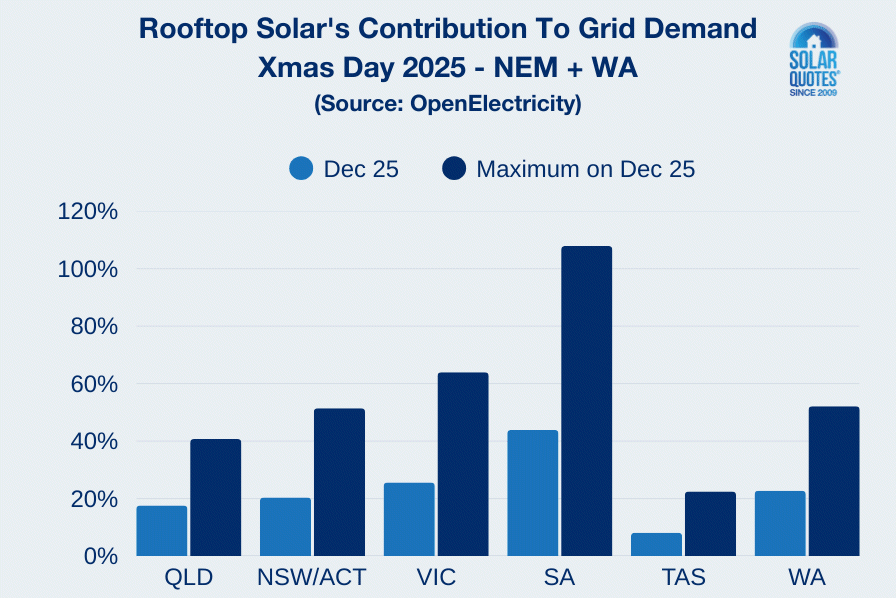
The total amount of solar energy fed back into the grid on this day across all regions (excluding NT) reached 135 gigawatt-hours, a testament to the extensive adoption of solar power.
Uptake of Rooftop Solar in 2025
As of November 30, 2025, the Clean Energy Regulator (CER) reported that 221,713 solar systems under 100 kW capacity had been installed. This figure was expected to rise significantly by year-end, as final accounting typically reveals higher totals following the registration period. In 2024, for instance, 319,044 systems were installed, suggesting that while 2025 installations may be lower, the upward trend in average system size—from 8.8 kW in 2021 to 10.2 kW in early 2025—reflects an increasing commitment to solar investment.
Since 2001, Australia has installed over 4.264 million home solar systems, positioning the country at the forefront of residential solar energy adoption.
Home Battery Adoption in 2025
A significant highlight of 2025 has been the introduction of the Cheaper Home Batteries Program (CHBP) by the Albanese Government, which launched in July. By the end of November, approximately 125,447 solar battery systems had been registered under this program. Additionally, there were thousands of batteries in the registration process, indicating strong demand.
Federal Minister for Climate Change and Energy Chris Bowen reported a total of 163,016 households that had installed batteries since the CHBP’s launch. This marks a sharp increase compared to the 75,000 home battery systems sold in 2024 and represents around 3.9 GWh of usable capacity, surpassing the five biggest utility-sized batteries currently operational in the NEM.
The success of the CHBP also led to upgraded installation capacities, jumping from an average of 10-12 kWh in 2024 to approximately 28 kWh since October 2025.
Additionally, with a robust registration pipeline for early installations, 2025 could potentially eclipse historical numbers of battery installations, further solidifying Australia’s energy independence.
Preparing for Solar Adoption in 2026
As the holiday season sees many solar installers taking a break, this presents an opportunity for those considering solar energy solutions to begin their research. If you’re looking to understand the process of installing solar, informative guides are available, helping you to prepare inquiries and quotes for when service providers resume operations.
Generous solar panel rebates, coupled with battery subsidies and declining costs, make 2026 a promising year for Australian households looking to embark on or continue their transition to solar power.
By focusing on these aspects, we not only celebrate the progress made in renewable energy adoption but also look ahead to a more sustainable energy future for all Australians.